There's a voice most of us carry that sounds a lot like wisdom but isn't.
It says things like: You're not qualified enough for that. People like you don't get to have that. It's too late. You should be further along by now.
It doesn't announce itself as a limiting belief. It announces itself as reality. And that's exactly what makes it so hard to shake.
Limiting beliefs are the invisible operating system running beneath your decisions, your relationships, your ambitions, and your sense of what's possible for you. Most people never examine them — which means they never change them. And so the same patterns repeat. The same ceiling appears. The same version of "almost but not quite" shows up again and again.
This post is about changing that. Not with affirmations pasted over pain, but with real, honest inner work — the kind that actually moves things.

What Is a Limiting Belief?
A limiting belief is a thought or assumption you hold about yourself, other people, or the world that constrains how you think, feel, and act. The critical distinction: it feels like a fact. It doesn't feel like a belief you chose — it feels like something that's simply true about you or about how the world works.
That's what makes them so sticky. You can't argue with something you don't know you're believing.
Limiting beliefs tend to cluster around a few core areas: worthiness, money, success, relationships, and identity. And for moms specifically, they often show up wrapped in the language of love — a good mom puts herself last, my dreams can wait until my kids are older, wanting more makes me selfish — which is exactly what makes them feel noble instead of limiting.
If you want to see 50 specific examples organized by category, including a whole section written specifically for moms, read this: 50 Examples of Limiting Beliefs That Are Quietly Keeping You Stuck.
Where Do Limiting Beliefs Come From?
Most limiting beliefs aren't formed consciously. They're conclusions your nervous system made — often in childhood, often in a moment of fear, shame, or pain — in order to make sense of an experience.
A teacher tells you your drawing isn't good. You conclude: I'm not creative.
Your family struggles financially growing up. You absorb: Money is hard and never enough.
You're told to stop being so emotional. You learn: My feelings are too much.
You watch a parent sacrifice everything for the family. You internalize: That's what love looks like.
None of these conclusions were chosen deliberately. They were protective responses — your brain trying to create a framework for navigating a confusing world. The problem is that those frameworks don't automatically update as you grow. They just keep running quietly in the background, shaping your choices, your self-perception, and your sense of what you deserve.
Bringing them into the light is the first step to changing them.
How Limiting Beliefs Actually Work (The Part Most People Skip)
Here's something most posts about limiting beliefs don't tell you: awareness alone doesn't create change.
You can read a list of limiting beliefs, recognize yourself in ten of them, feel a moment of clarity — and still act from those same beliefs the next day. Why? Because a limiting belief isn't just a thought. It's a felt sense in your body. It's an identity. It's been rehearsed thousands of times and has neural pathways to prove it.
Slapping a positive affirmation on top of it doesn't work because the belief is sitting deeper than the affirmation can reach. You can repeat "I am worthy" while your body is fully convinced otherwise — and the body always wins.
What actually works is a process: feeling through the belief, understanding where it came from, telling a truer story, and rehearsing that story consistently until it starts to feel more real than the old one. That's not magic. That's neuroplasticity — the brain's ability to form new pathways when given new input consistently over time.
Journaling is one of the most effective tools for this process, because it forces you to externalize what's internal. You can't examine what's still inside your head. Getting it on the page is what makes it workable.
If you're ready to start doing this work with a guided journal built specifically for it, the (more) Magic journal has an entire Worthiness chapter designed around exactly this process. More on that below.

A Step-by-Step Process for Rewriting a Limiting Belief
Work through this with one belief at a time — trying to tackle all of them at once is how you end up overwhelmed and back to square one.
Step 1: Name it exactly as it sounds
Write out the limiting belief in your own words — not a cleaned-up version, the raw version. The way it actually sounds in your head at 2am or when something doesn't go the way you hoped.
Not: "I sometimes struggle with self-worth."
But: "I don't think I'm actually capable of building something real."
Specificity is everything here. Vague beliefs produce vague shifts. Get precise.
Step 2: Trace it back
Ask yourself: when did I first start believing this? You don't need a perfect answer — you're not doing therapy, you're building awareness. Even a rough sense of origin helps dissolve some of the belief's authority. It stops being the truth and starts being a conclusion I made at eight years old based on incomplete information.
Also worth asking: does this belief actually belong to me — or did I inherit it from someone else? A parent, a teacher, a culture, a religion? You'd be surprised how many of your core beliefs were never yours to begin with.
Step 3: Question its validity
Not with toxic positivity, but with genuine curiosity. Ask:
- Is this actually true — or does it just feel true?
- What evidence do I have that contradicts this belief?
- Has this belief ever been wrong before?
- Would I say this to someone I love?
The goal isn't to convince yourself the belief is false. The goal is to create enough distance from it to see it as a story rather than a fact.
Step 4: Write the truer story
Now write an alternative — not the opposite, not a forced positive spin, but a genuinely truer and more expansive version of the belief.
Not: "I'm not capable of building something real" → "I am incredible and unstoppable!"
But: "I'm not capable of building something real" → "Other people with less experience than me have built real things. There's no actual evidence I can't. What I haven't done yet is different from what I'm not capable of."
The truer story doesn't have to be fully believable yet. It just has to be more honest than the limiting one.
Step 5: Rehearse it consistently
Write from the emotional state of the version of you who has already released this belief. Not "I hope one day I'll believe I'm worthy" but "I am someone who knows her value and acts from that place." Get into her body on the page — what does she believe, how does she move, what does she say yes and no to?
Done consistently — three or more times a week — the new story starts to feel more true than the old one. The neural pathway for the limiting belief gets weaker. The new one gets stronger. That's the whole mechanism.
Common Limiting Beliefs and Their Honest Reframes
A few of the most common ones, reframed not with empty positivity but with something that might actually land:
"I'm not good enough."
Reframe: Good enough for what, exactly — and who decided the standard? Most "not good enough" beliefs were installed by someone who wasn't qualified to measure your worth. The standard itself is worth questioning.
"It's too late for me."
Reframe: Too late is a story, not a fact. The research on neuroplasticity, career pivots, and life reinvention consistently shows that meaningful change is possible at any age. "Too late" is what the part of you that's afraid of trying tells the part of you that wants to.
"I don't deserve what I want."
Reframe: Deserving is not a prerequisite for wanting, and wanting is not the same as taking from someone else. What you want can coexist with being a good person, a good mom, a good partner. These are not opposites.
"A good mom puts herself last."
Reframe: A mom who puts herself last consistently ends up depleted, resentful, and modeling self-abandonment for her children. Taking care of yourself is not in conflict with taking care of them. It's a prerequisite for it.
"I'll never be able to change."
Reframe: You have already changed — multiple times, in ways you couldn't have predicted. The belief that you can't change is itself a belief that can be changed. That's either a paradox or an invitation, depending on how you look at it.

The Journals That Support This Work
Understanding limiting beliefs intellectually is one thing. Doing the actual work of rewriting them is another — and that's where a guided journal becomes essential. You need a container that holds the process, so you're not starting from scratch every time you sit down.
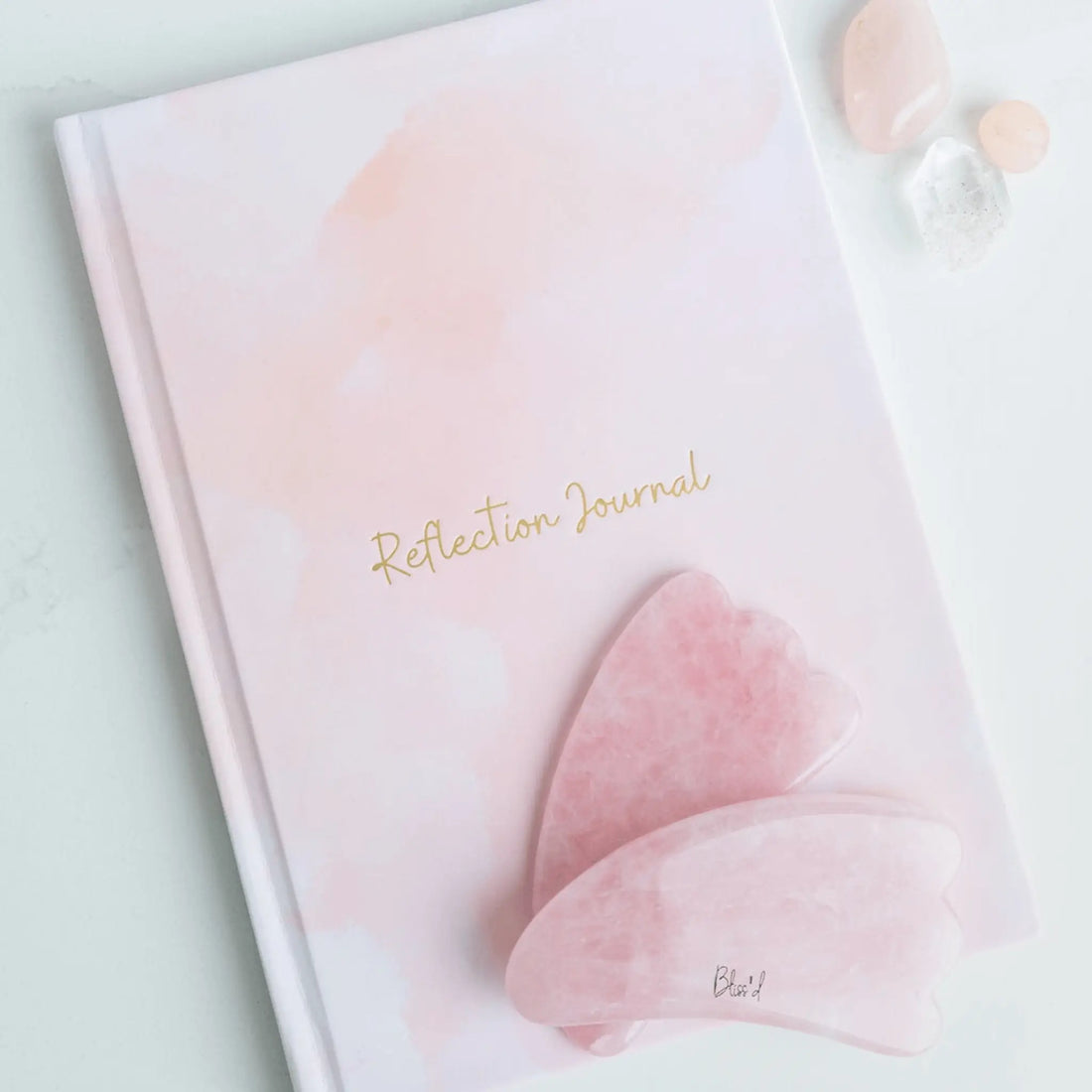
(more) Magic Manifestation Scripting Journal — For deep limiting beliefs work
(more) Magic was specifically built for this. The first chapter — Worthiness — walks you through the exact process above: naming the beliefs you've been operating from, feeling through where they came from, and building a new identity on the other side. Over six months and five themed chapters, you'll work through the patterns that have been running your life underneath the surface. This isn't journaling as a feel-good activity. It's journaling as real transformation.
Buy direct: blissd.co — $24.99
Buy on Amazon: Amazon — from $24.99
Magic Guided Journal for Beginners — If you're new to journaling
Start here if you don't yet have a consistent journaling practice. Magic builds the daily habit — the consistency, the emotional awareness, the muscle of returning to yourself — that makes deeper work like limiting beliefs actually stick. Ninety days, five minutes a day, no experience needed.
Buy direct: blissd.co — $19.99
Buy on Amazon: Amazon — from $19.99
Magic Journal Bundle — The complete system
Both journals together at 10% off — the full nine-month journey from building your daily practice to using it for lasting transformation. If you're serious about doing this work, this is where I'd start.
Buy direct: blissd.co — bundled + discounted
Frequently Asked Questions About Limiting Beliefs
What are the most common examples of limiting beliefs?
The most common limiting beliefs cluster around worthiness ("I'm not good enough"), money ("I'll never be financially secure"), success ("It's too late for me"), relationships ("I'm hard to love"), and identity ("I can't change"). For moms specifically, limiting beliefs often sound like: "A good mom puts herself last" or "My dreams have to wait until my kids are older." For a full list of 50 examples organized by category, read: 50 Examples of Limiting Beliefs That Are Quietly Keeping You Stuck.
How do limiting beliefs form?
Most limiting beliefs form in childhood or during emotionally charged experiences when your nervous system made a quick conclusion to make sense of what was happening. A moment of shame, fear, rejection, or pain becomes a rule you carry forward: "I'm not smart enough," "People leave," "I have to earn love." These beliefs weren't chosen consciously — which is also why they can be unchosen with the right process.
Can limiting beliefs actually be changed?
Yes — but not through willpower or positive affirmations alone. Limiting beliefs are stored in the body as felt experiences, not just the mind as thoughts. Real change requires feeling through the belief, understanding its origin, replacing it with a truer story, and rehearsing that story consistently enough for new neural pathways to form. This is the science of neuroplasticity, and it's exactly what a consistent journaling practice supports.
How long does it take to overcome a limiting belief?
It depends on how deeply rooted the belief is and how consistently you work with it. Surface-level beliefs — ones you can intellectually challenge fairly easily — can shift noticeably within a few weeks of consistent journaling. Deeply held beliefs tied to identity or early trauma take longer and may benefit from additional support like therapy or coaching alongside journaling. The key is consistency over intensity: three times a week for several months is more effective than a weekend retreat followed by nothing.
What's the best journal for working through limiting beliefs?
A guided journal is significantly more effective than a blank one for this kind of work, because it removes the friction of deciding what to write and holds the process for you. The (more) Magic journal was specifically designed for limiting beliefs work — the Worthiness chapter walks you through the full rewriting process step by step. If you're newer to journaling, start with the Magic Guided Journal to build the daily habit first, then move into (more) Magic for deeper transformation work. Both are available at blissd.co and on Amazon.
Are limiting beliefs the same as negative thoughts?
Not exactly. Negative thoughts are situational — they come and go in response to events. Limiting beliefs are structural — they're the underlying assumptions that generate negative thoughts repeatedly. A negative thought might be "I'm going to mess up this presentation." The limiting belief underneath it is "I'm not capable." Working on the limiting belief addresses the root; managing negative thoughts individually only addresses the symptoms.
How do I know if I have a limiting belief vs. a realistic assessment?
Great question — and an important one. The difference usually comes down to this: a realistic assessment is based on current, specific evidence and remains open to updating. A limiting belief feels absolute, applies broadly, has been with you for a long time, and tends to shut down possibility rather than inform it. "I don't have the skills for this specific role yet" is a realistic assessment. "I'll never be successful" is a limiting belief. The first one points toward action. The second one closes the door entirely.
The Bottom Line
Limiting beliefs are not character flaws. They are not evidence that something is fundamentally broken about you. They are conclusions — made in moments of pain or fear or confusion — that your nervous system has been running on autopilot ever since.
The fact that they're conclusions means they can be reconsidered. The fact that they're stories means they can be rewritten. And the fact that you're here, reading this, actively looking for the language to name what's been holding you back — that already means you're doing the work.
Pick one belief. The one that came to mind while you were reading. Write it down today. That's where it starts.
And if you want a journal that holds the process for you — so you're not figuring it out alone every time you sit down — that's exactly what the Bliss'd journals are built for. Start with Magic if you're building the habit, or go straight to (more) Magic if you're ready for the deep work. Both available at blissd.co and on Amazon (Magic | (more) Magic).
— Allie
Want to go deeper? Read these next:
50 Examples of Limiting Beliefs Organized by Category (+ Journal Prompts to Rewrite Them)
Manifestation Journaling for Moms: The 7-Minute Practice That Actually Fits Your Life
Journaling for Moms: How to Finally Make It a Habit When You Have No Time and No Energy